
Feeling Minnesota
Taking Paul Bunyan to the Southern Border

Well I just looked in the mirror, and things aren’t looking so good
I’m looking California and feeling Minnesota.
Soundgarden
Sitting under a tree, shaded from the hot sun in Ciudad Juárez, Mexico, it was my turn to tell a story. We were a mixed group—some from the United States and others from various countries in Central and South America. They had traveled to the border for the chance to come to the United States. Many of them fled from violence and persecution, hoping for a better life. Now here we were, together under a tree in a park in Juarez, waiting for me to say something interesting.
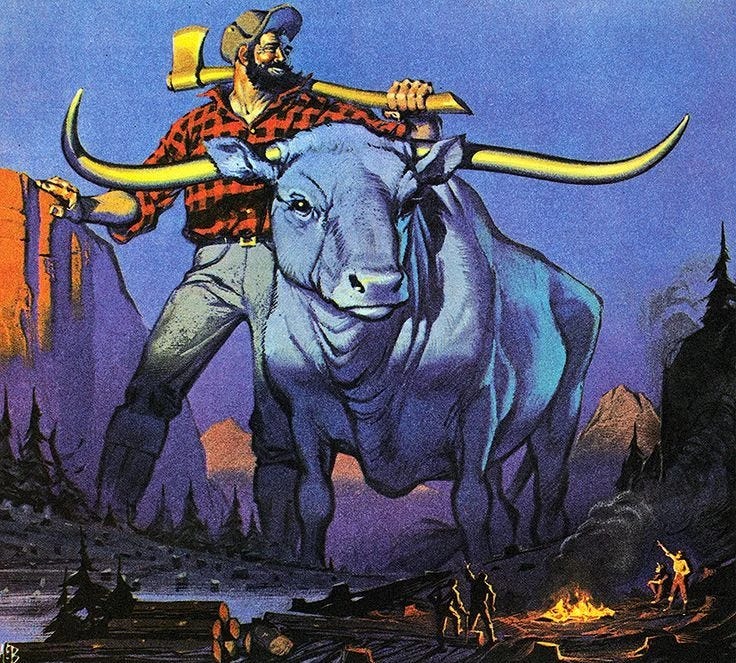
So I told them the story of Paul Bunyan and his blue Ox, Babe. I told them about this mythical land, way up North, called Minnesota. A place of 10,000 lakes and beautiful forests, settled by Scandinavians and Northern Europeans and, if you believe the stories, the Vikings! I described how the lakes were formed by this giant lumberjack whose footprints (and his arse!) formed the many lakes dotting the landscape. “Believe it or not,” I said, “He’s still in Minnesota, if you know where to look.” I told them how as a kid my family visited a place called Brainerd, where Paul Bunyan sits on a large chair, welcoming people by name. I remember hearing my name, and staring in awe at this large flanneled giant. How did he know who I was? I described the beauty of Minnesota lakes in the summer and the majestic snow that blankets the ground in winter. How the cold grabs hold of you, slaps you in the face, letting you know you are alive! I ended with an invitation: “When you make it across the border, come and visit! It is the closest thing to God’s new creation you’ll ever find.”
As I finished, a young man quickly walked over to me with his phone out. He showed me a picture of his home in Columbia near a beautiful pool of water where his wife and young son were swimming. Through a translator I listened as he described his home…the most beautiful place on earth, one that he was forced to leave. Another woman told me about Guatemala, and how she missed her home and her family. Some of the young children tugged on my beard—in their mind I was a mythical giant, maybe even Paul Bunyan in disguise.
Whenever I hear the line “feeling Minnesota” from the Soundgarden song, Outshined, I beam with pride. I don’t care if it’s meant to be negative—I make it mean what I want it to mean. Minnesota has shaped my identity. From my time in Willmar, MN hearing my grandfather tell stories about his time on the railroad, and his time fighting Nazi’s in WWII, to swimming in the crystal clear, cold, water of Green Lake—my memory is full of blue collar, hard working, people and beautiful days spent outside under blue sky.
For one year, my family lived in Minneapolis as I started my PhD. We explored every possible neighborhood—from downtown to uptown, to South Minneapolis, to the North; to Powderhorn park to Franklin Ave. Growing up, I heard my family tell stories about Hennepin Ave.—it was this crazy mythical place. During this year, we went to Hennepin Ave. often, attending St. Mary’s Basilica and my church of baseball—Target Field. In every part of the city, there is a mixture of cultures, from Lake Street, to Park and Portland Aves, and the Midtown Global Market. When anyone asks me where I’d like to live someday, I usually answer Minneapolis—going to mass at St. Mary’s, living in a downtown apartment within walking distance of my work as an usher at Target Field.
Yes, the events of these past weeks have made me incredibly sad. The violence and fear that continues to terrorize our immigrant friends and neighbors is horrific. So, too, is the senseless loss of life. But deep down, I’m both proud and hopefully. Proud that the people of Minnesota have stood up against the violence and hate. Proud that so many people have stepped up to take care of their neighbors, to meet their needs in this time of trouble. And hopeful because I know, one day, Minneapolis will flourish again. Minneapolis and Minnesota will come out the other side stronger because of the presence of our immigrant friends. For now we mourn, we lament, we struggle, and we fight. As Paul says, our fight is not against flesh and blood, but the principalities and powers of this present age—every form of hateful ideology and rhetoric that incites violence against our neighbors.
Who knows? In a few years maybe I’ll bump into the new friends I met in Ciudad Juárez, as we walk through the entrance to the park and hear Paul Bunyan greet us by name.
Well done Mr. Lief!
Thank you Jason. I appreciate this article very much.